This project addresses a critical challenge in the banking sector: incorporating Net Inflow forecasts as a starting point for budget planning. Developed as part of the Fundamentals of Business Management course for the CCH Tagetik Business Data Challenge , the project focuses on creating a comprehensive forecasting system that leverages macroeconomic data and operational costs to perform margin simulations and enable financial institutions to react to adverse scenarios.
The core deliverable is an interactive dashboard featuring key performance indicators essential for conducting what-if analyses. This tool empowers users to examine how changes in macroeconomic conditions and business assumptions impact Earnings Before Interest and Taxes, enabling strategic decision-making in dynamic market conditions. The project team, comprising Cattari Simona, Poiani Marco, Carella Alessandro, and Jallow Ebrima, extracted data from the top five Italian banks by assets (Unicredit, Intesa Sanpaolo, MPS, BPER Banca, and Banco BPM) covering the period from 2018 to 2022, deliberately including data before and during the COVID-19 pandemic to assess the impact of significant macroeconomic events.
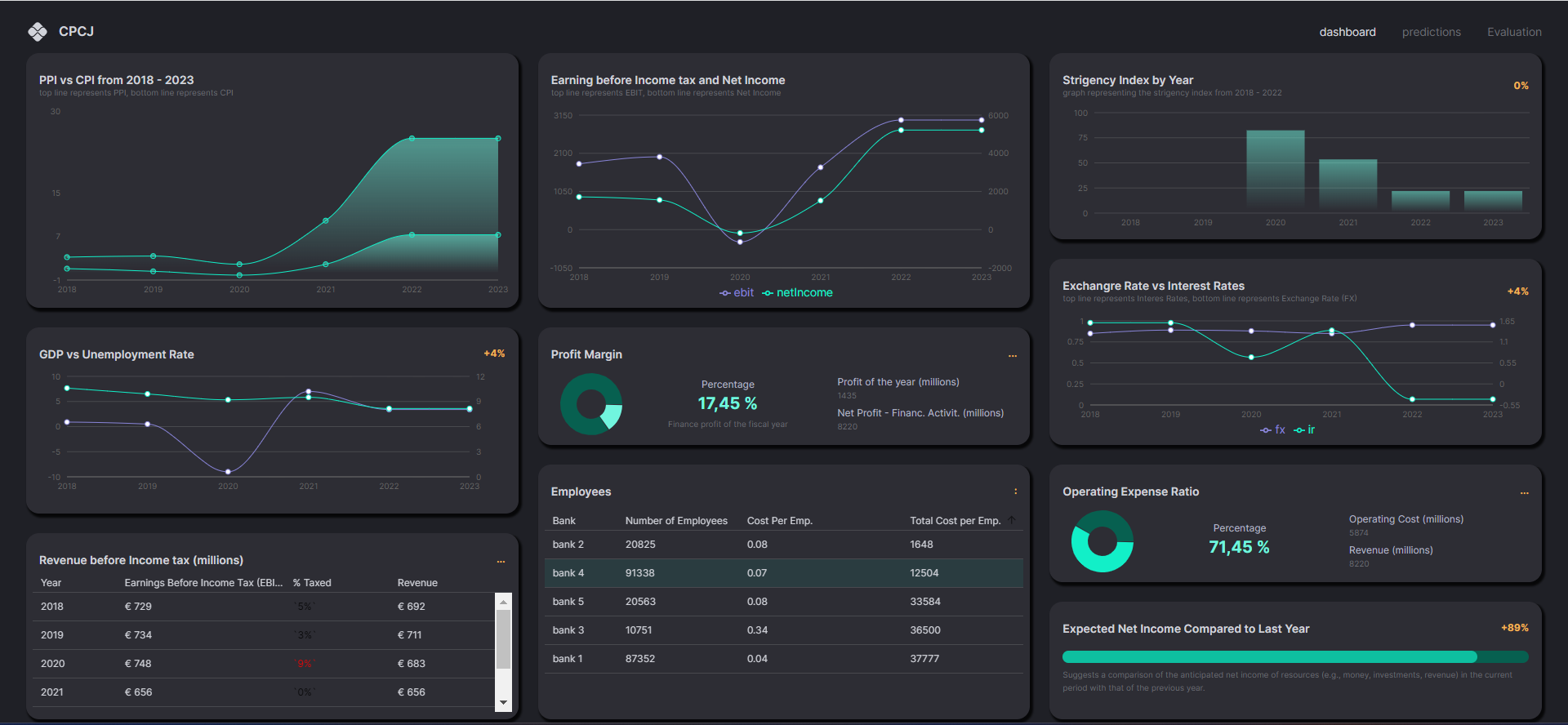
Through this project, I gained comprehensive insights into financial forecasting and business analytics in the banking sector. I developed a deep understanding of financial statement analysis, particularly consolidated Profit and Loss statements, learning to identify and extract the most relevant items such as Net Interest Margin, Net Fees and Commissions, Operating Income, and Administrative Expenses. These elements proved crucial in understanding a bank's financial health and operational efficiency.
I learned to work with critical macroeconomic indicators including GDP, unemployment rates, Producer Price Index, Consumer Price Index, exchange rates, real interest rates, and the COVID-19 Stringency Index. Understanding how these external factors influence banking performance was essential for creating accurate forecasts. The project taught me that while banks can control their internal operations to some extent, macroeconomic factors play an equally important role in determining end-of-year financial outcomes.
From a technical perspective, I mastered the selection and implementation of machine learning models suitable for small datasets. Working with only 25 samples and 49 features, I learned why models like Linear Regression, Ridge, Lasso, ElasticNet, and Decision Tree Regressors are particularly effective in such scenarios. I gained hands-on experience with multiple evaluation metrics including Mean Squared Error, Mean Absolute Error, R-squared score, Explained Variance Score, Accuracy, Precision, Recall, and F1 Score, understanding that relying on multiple metrics provides a more robust assessment when traditional cross-validation isn't feasible due to limited data.
The project significantly enhanced my full-stack development capabilities. I learned to integrate machine learning models with web applications using Django for the backend and React with Material UI for the frontend. Working with the scikit-learn library deepened my understanding of model serialization, data preprocessing with StandardScaler, and creating RESTful API endpoints for frontend-backend communication.
Importantly, I learned about the challenges of working with real-world financial data, including the importance of data transparency, the differences between individual and consolidated financial statements, and the need to balance comprehensive analysis with user experience. The project taught me to think strategically about presenting complex financial information in an accessible way, making sophisticated forecasting tools usable for business decision-makers who may not have technical backgrounds.